How Long Does Post Construction Cleaning Take?
On a construction schedule, the final clean sits right before handover — so “how long does post construction cleaning take?” is really a question about hitting your certificate-of-occupancy date. The honest answer: it depends on square footage, phase, dust level, and crew size. Here’s a realistic planning guide.
Rough timeline by square footage
These are planning estimates for a standard commercial final clean with an appropriately sized crew. Heavy glass, high ceilings, and compressed schedules change the math.
| Project size | Final clean (planning estimate) | Crew |
|---|---|---|
| Under 5,000 sq ft | 1 day | 2–3 cleaners |
| 5,000–15,000 sq ft | 1–2 days | 3–5 cleaners |
| 15,000–40,000 sq ft | 2–4 days | 5–8 cleaners |
| 40,000+ sq ft | Phased over several days | Scaled crew |
Need it faster? A professional company scales the crew and adds nights and weekends to hit a compressed certificate-of-occupancy date. Timeline is a function of crew size, not a fixed number.
What speeds it up
- A larger crew and a clear, walked scope of work
- A rough clean already done between trades
- Site access — reserved elevators, loading dock, and power/water on
- Other trades finished (fewer people re-dusting the space)
What slows it down
- Heavy drywall dust and adhesive residue
- Extensive floor-to-ceiling glass and high dusting
- Trades still working and re-contaminating cleaned areas
- Floor finishing (strip/wax/seal) that needs cure time
Timeline is a function of crew size, not a fixed number
The single most important thing to understand about post-construction cleaning timelines is that they’re elastic. The same 20,000-square-foot office might take four days with a three-person crew or a day and a half with an eight-person crew. When a general contractor says “we can’t move the CO date,” the right answer from a cleaning partner isn’t “then it can’t be done” — it’s “then here’s the crew size we’ll bring.”
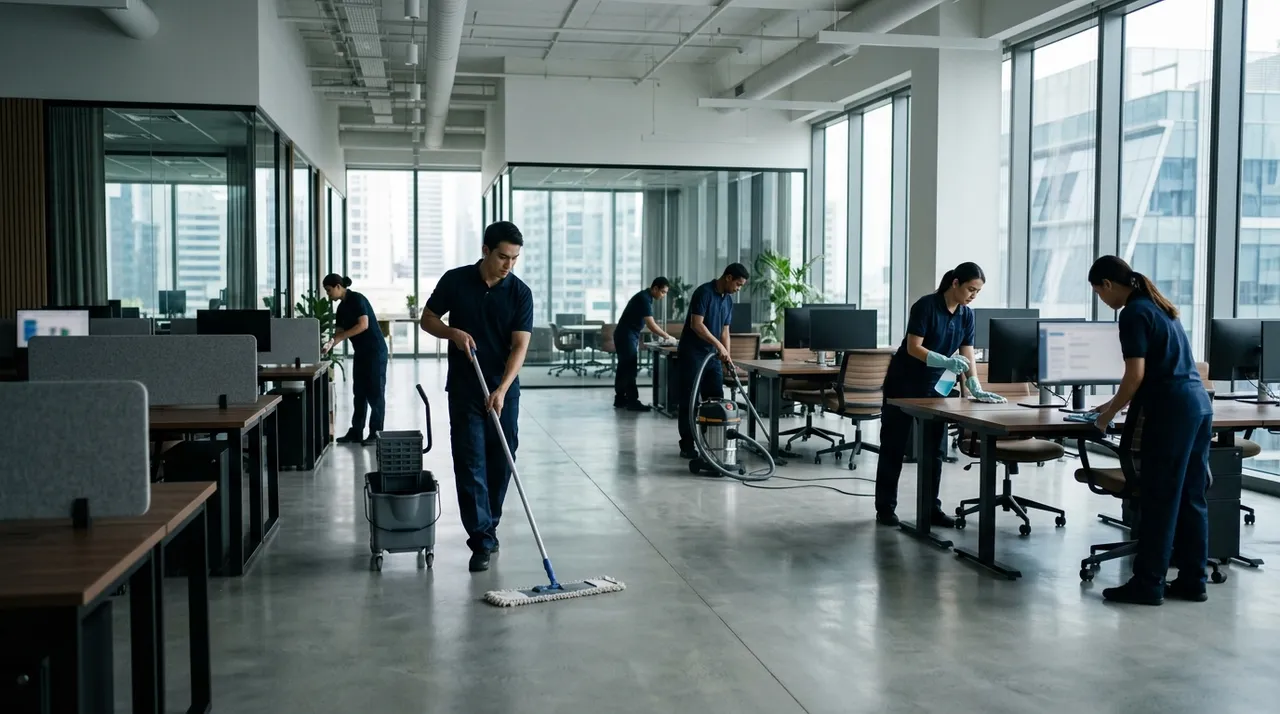
This is why cheap, undersized crews are a false economy on a deadline-driven project. A two-person crew on a large final clean will either miss the handover date or rush and leave dust that fails the walkthrough. A properly sized, properly equipped crew hits the date and the quality bar at the same time.
What a final-clean timeline actually looks like
For a mid-size commercial build-out, a well-run final clean typically flows in this sequence. Understanding it helps you slot cleaning into the overall construction schedule without collisions.
- 1High dusting first — ceilings, ductwork exteriors, vents, and fixtures, so everything that falls lands on floors that haven’t been cleaned yet.
- 2Surfaces and details — walls, ledges, cabinetry, hardware, and residue/sticker removal.
- 3Glass — interior and exterior windows, frames, and tracks, cleaned streak-free.
- 4Restrooms and kitchens — sanitized and detailed.
- 5Floors last — scrubbed, polished, or finished by surface type, working toward the exit.
This top-down sequence is why cleaning should be one of the last trades on site. If painters or installers come back after the final clean, dust resettles and you pay for a touch-up pass — which is exactly what the third phase is for.
Real-world examples
A few illustrative scenarios, assuming an appropriately sized crew and a space that other trades have finished with:
- A 3,000 sq ft medical suite with moderate glass: a single day for a full final clean with a two-to-three-person crew.
- A 12,000 sq ft open-plan office: one to two days with a four-to-five-person crew, longer if there is extensive floor-to-ceiling glass.
- A 30,000 sq ft build-out with high ceilings and lift work: three to four days, or fewer with a larger crew and split shifts.
- A 60,000+ sq ft distribution center: phased over several days with a scaled crew and dedicated high-dusting equipment.
How to protect your handover date
- 1Book the cleaner early and share your CO date up front — don’t wait until the space is finished.
- 2Sequence the final clean after the last dusty trade so you clean once, not twice.
- 3Confirm the crew size matches the timeline you need, in writing.
- 4Reserve elevators, loading docks, and confirm power and water are on.
- 5Leave a buffer day for the touch-up/punch-list pass after inspection.
Frequently asked questions
Can post-construction cleaning be done overnight?
Yes. Night and weekend work is standard on deadline-driven projects and on occupied-adjacent sites. It lets the cleaning crew work without colliding with other trades and delivers a finished space by the next morning.
How far in advance should I book?
Share your target handover date as early as possible and confirm the booking at least a week out for larger projects. The more notice, the easier it is to guarantee the crew size your timeline requires.
What happens if trades run late and push my clean?
A flexible cleaning partner scales the crew to compress the timeline, adds nights and weekends, and phases the work so a delayed trade in one area doesn’t hold up cleaning in another. That flexibility is exactly what you’re paying a professional for.
How dust level changes the clock
Two projects of identical size can take very different amounts of time based on one variable: how much dust and residue the trades left behind. A tightly managed site where drywall crews cleaned up after themselves gives the cleaning crew a head start; a site with heavy sanding dust caked on every ledge, adhesive on the glass, and paint overspray on the floors takes substantially longer. This is why an honest cleaner wants to see the space (or at least recent photos) before committing to a timeline — the square footage tells only half the story.
Don’t forget cure and dry times
One scheduling factor that catches teams off guard is floor finishing. If your scope includes strip-and-wax or sealing, the finish needs time to cure before the space can take traffic — often several hours per coat, sometimes overnight. Bake that into the schedule so the floors aren’t walked on before they’re ready, which would mean redoing them and losing a day.
A sample two-phase schedule
Here’s how a final-and-touch-up sequence might lay out for a mid-size commercial build-out with a firm certificate-of-occupancy date. Adjust for your square footage and crew size.
| Day | Activity |
|---|---|
| T-minus 3–4 days | Final clean begins: high dusting, surfaces, glass |
| T-minus 2–3 days | Floors scrubbed and finished; cure time |
| T-minus 1–2 days | Inspection and any punch-list trade work |
| T-minus 1 day | Touch-up clean: fingerprints, fresh dust, final glass |
| Handover day | Joint walkthrough and sign-off |
The key is that the final clean lands after the last dusty trade and the touch-up lands after inspection — so you clean forward, not in circles.
Residential vs. commercial timelines
Residential post-construction cleaning — a new home or a remodel — usually wraps in a day or two because the square footage is smaller and the finishes are more uniform. Commercial projects take longer per job not just because they’re bigger, but because they carry more glass, higher ceilings, more restrooms, stricter appearance standards, and coordination with a general contractor and other trades. A 3,000-square-foot house and a 3,000-square-foot medical suite are not the same clean, and the suite will take longer.
Questions to ask about timing before you book
- How many crew members will you bring, and how does that map to my deadline?
- Can you split the work across day and night shifts to compress the schedule?
- When do you need the space cleared by other trades to start?
- How much buffer should I leave for the touch-up pass after inspection?
- If a trade runs late, how do you adjust to still hit my CO date?
The answers tell you whether a cleaner is thinking about your schedule as carefully as you are — which is exactly the partner you want on a deadline-driven handover.
Related: The 3 Phases of Post Construction Cleaning
Estimate your cost: Post Construction Cleaning Cost Calculator
Key takeaways
- Timeline is a function of crew size — a bigger crew compresses the schedule.
- A small suite may take a day; large projects phase over several days.
- Dust level, glass, height, and site access all move the clock.
- Sequence the final clean after the last dusty trade, and leave a buffer for touch-up.
- Share your certificate-of-occupancy date early so the crew is sized right.
When someone asks how long post-construction cleaning takes, the real answer is “how fast do you need it?” A professional crew scales to your deadline. Book early, share the date, and confirm the crew size in writing — and the timeline becomes a plan instead of a gamble.
Working toward a tight handover date?
See our post construction cleaning service